I start most "school" days with a plan, but we have a problem.
We are distracted.
Window staring is the worst. I personally have a highly evolved skill of staring, not only out the window, but at the ceiling and even at an actual blank wall for minutes, even hours, if inspired.
I'd like to claim that I'm involved in Zen-like peaceful meditation, but the opposite is true. My mind is not empty. I am not still. I am racing with thoughts, ideas, scenarios for apocalyptic movies starring ME as the hero. My overactive imagination is so busy that it shuts down my body and I stare.
My kids are the same.
Every open window is a distraction. Birds are interesting. So are the cars that drive by.
And nothing evokes the magic of the Great Outdoors like actual “school” work. Math worksheets entice squirrels to come up to our porch, draw their little rodent paws across their chests in an eerily human posture and whisper with their shiny black eyes, “Feed me, please.”
We feed two neighborhood squirrels: a skinny, formerly saber-toothed she-squirrel named “Toothy” and “Bruce” a big, fat he-squirrel whose cropped tail makes him look more like a beaver.
We feed Toothy because she is our walking, scurrying miracle. When she arrived several weeks ago she was nearly starved to death. She had patchy fur, a sparse twitching tail and a grossly misshapen face from two odd, overgrown teeth protruding from her lower jaw. She looked like a harelip squirrel.
So the kids and I talk about harelips and wonder if the condition occurs in squirrels. We Googled Smile Train and watched tear-jerking videos of compassionate doctors repairing harelips in third-world children. We talk about health care in third-world countries.
We talk about how people are doing small things to make a big difference in other people’s lives globally. We discuss the great questions of civilization.
And then it's lunch time and Bruce comes around.
We don’t actually like feeding Bruce. He is a fat little guy who bullies Toothy into giving up her factory-shelled walnuts. Sometimes we throw him a nut or two to distract him while our little squirrel nourishes herself.
Toothy is doing better now. She doesn’t have to cock her head to one side to painfully choke down her nuts. Her superfluous teeth fell out, and she almost looks normal now.
But the kids wonder where she lives.
What does her nest look like?
We look in the palm trees. We Google “where do squirrels live.”
My daughter disappears into her room to finish her lesson on negative and positive numbers -- added and subtracted, multiplied and divided.
It sounds easy enough until I have to explain how a negative number divided by a negative number becomes a positive number – every time. It is not enough to know that it happens. She has to know why and in what real life situations. I didn’t buy the teacher’s guide.
It comes down to a comparison with “I don’t have no cookies,” and she accepts that for now. I return to focusing on my son and his times tables. He has gone to wash his hands and returns 10 minutes later with a bubble delicately balanced between his thumb and forefinger. He is grinning.
“Look Mom!”
He explains how he did it.
I try to listen and not be irritated because I really had planned on him learning his times tables, maybe just one of them, this afternoon.
I had also planned on writing a little this afternoon. But of course, five minutes into the writing project my thoughts are interrupted by something important like a sudden need to fold laundry or update Facebook with a pithy little status about feeding saber-toothed squirrels.
I know that planning and taking deliberate steps toward a goal yield success. So I worry that all this distraction is hampering my children’s overall education.
There are those comforting unschooling “folktales” about children who follow their passions and arrive in adulthood with their creative energy and self motivation uninhibited.
But then there are also people who can’t keep a job because they are bored and distracted. Somehow I am hoping this is different.
Currently my favorite absolution on distraction comes from the highly imaginative writer, Norton Jester, who wrote The Phantom Toolbooth.
Apparently he wrote that book when he was supposed to be working on another project. Ironically his little escape became his greatest work. He has been quoted as saying “I find the best things I do, I do when I'm trying to avoid doing something else I'm supposed to be doing.”
So yes, we never get as much done as I plan. But I’m hoping that my kids schooling experience is better because of the distractions and not in spite of them.
Three hours later, my daughter returns from the bedroom, half-finished math assignment in hand.
“Mom, I just wrote the best song!”
More Distractions
And now more distractions to entertain you and keep you from what you should be doing.
He was suppose to be coping the paragraph from the whiteboard behind him. I left him alone and found him like this 10 minutes later. It's a Cheerio map to the treasure.
What do you do when you find your kids and their friends walking on the wall?
You try it too!
How much time can you "waste" on time lapse photos of the electric trains in the night? When was bedtime suppose to be?
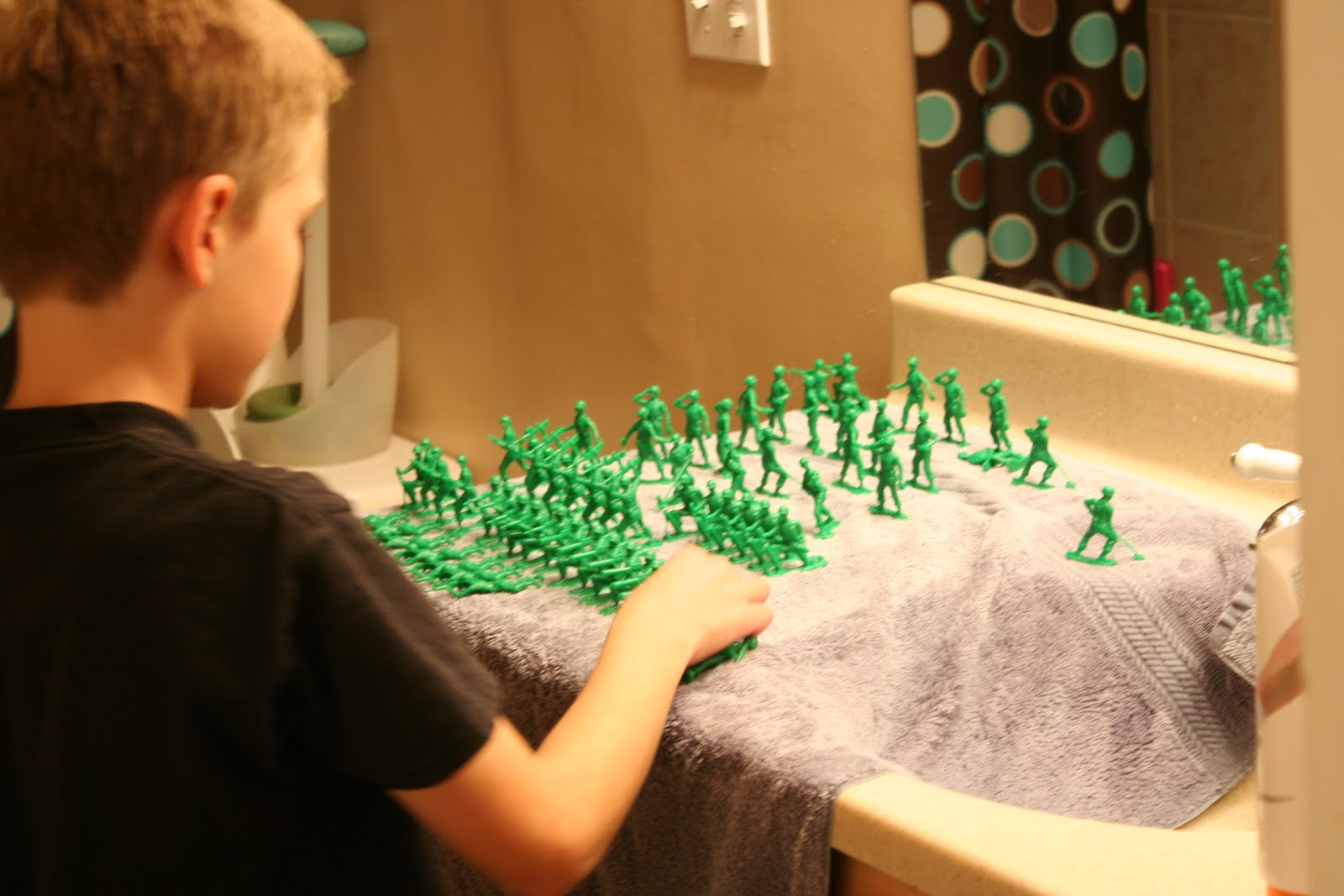
And since when does "clean up your toys," mean wash and dry the entire army?
And if all else fails, quick, find a tree and climb it before you get too old.
 with his stuffed animals and with us. Last night we finished the first game ever. I remember playing Monopoly alot with my sister when I was about that age. The game would go on forever and never finish. I always thought that was a tragedy, but actually playing out an entire game last night made me realize a truth about Monopoly, and maybe Capitalism in general: it's just not fun to play it all the way out. The richer the rich get and the poorer the poor get, the less fun it is for everyone. Even the rich guy felt bad cleaning everyone out.
 . Is that still around? I guess so, since I just found an Amazon link. LOL. The cover looked different in the 70s and 80s when our family played it.




 Susan Wise Bauer’s
  method,
  ideas, and just about anything else that my friends have been excited about at one time.
 . I admire people who follow the full Sonlight curriculum, or allow their kids a rich unschooling environment, but I know it doesn’t work for us.
 concept of "structuring time not content," and an article I read about a large homeschooling family who uses
  by Jessie Wise. I think it was written for first and second graders, so we are moving through it pretty quickly, but he is learning basic things like the definition of a noun and the difference between a proper and a common noun.
 s and has never really wondered what a noun or verb was since then. At some point in the next year I would like to go through a more intensive study of grammar with her, but for now, it is not a priority. She is learning other things on her own.
 phonics book. Once we preview the phonics workbook he can work through it on his own.
 books. Since we started this his drawing and his handwriting have improved.